State of Docker Compose Security¶
This is the canonical, citable version of the State of Docker Compose Security report. Tracking issue: #186.
Third edition. Pinned to compose-lint 0.26.0 and corpus run
20260827T190923Z(11,111 files, 2026-08-27). Snapshot archive:compose-lint-corpus-11111-20260827.tar.gz, sha256049d2b5bf7167f0ca694aca23fa5483c761fbfccfa2ca7b78520a4ba8b3a5f98.What this edition can and cannot compare. The 5,417 files behind the previous edition are a subset of this corpus, archived and relinted here with the new tool — so for the first time, a same-files delta is legitimate and is reported in § What changed since the last edition: it isolates two weeks of rule-set change from corpus drift, exactly as the edition discipline demands. The 5,694 files new to this corpus (a deeper longtail sweep and the new overlay stratum) extend coverage; numbers over them are a new baseline, not a trend.
This edition also folds in the previous edition's two 2026-08-27 revisions — the seven-tier composition re-cut and the statistical review — as its native methodology, and fixes a measurement artifact both revisions had to work around: files in which nothing was linted (obsolete Compose v1 layouts, structural fragments) are now a separate skipped population, never counted as "clean".
The first published empirical study of security misconfigurations in real-world Docker Compose files at corpus scale.
TL;DR¶
- 99.2% of real-world Docker Compose files that lint carry at least one security finding (5,860 of 5,907 parsed files across the five prevalence tiers; 47 clean files remain in a corpus of 11,111). Earlier editions reported ~90–91%; most of that gap was files in which nothing was actually linted, now bucketed honestly — see § Skipped is not clean.
- Hardening practice is not improving over time. Findings per service are flat across file age within every tier (corpus-wide: 5.98 for files authored in the last year, 5.96 at 1–3 years, 5.82 at 3+). The gap this report documents is how Compose files are written now, not legacy debt aging out. Replicated on 2,035 files fetched after the claim was first made.
- Popular projects' files are the most exposed — because they're bigger, not sloppier. Per service, every tier misses hardening at nearly the same rate (5.8–6.3 findings per service). Ordinary ≥50★ projects write 3.3 services per file against the templates' 1.5–2, so their files carry ~20 findings each, and 16.1% of them mount a host control socket (6.0% of their services — 2.5× the longtail rate per service).
- Overlay files are a live, unhardened surface. The new
overlaystratum (3,579*.override.*/*.prod.*/*.dev.*files) shows multi-environment Compose is current practice, overlays are mostly full parallel files rather than sparse patches — and dev/local variants carry literal credentials at 1.7× the full-file rate. - The same four rules lead every tier: filesystem not read-only, no capability restrictions, no resource limits, privilege escalation not blocked — each fires on 97–99% of parsed files.
- Every one of the 27 rules fires on real files. None is dead, and there were zero crashes and zero timeouts across 11,111 linted files.
The framing is descriptive, not inferential. Read § What this study does NOT claim before citing any number from this report.
Methodology¶
Corpus¶
The corpus lives outside the repo at ~/.cache/compose-lint-corpus/. Each unique compose file is stored by content hash; an index maps content hash → source repo, path, blob SHA, tier, repo metadata, and the authored date of the captured content (blob_authored_at). The fetch + lint pipeline is in scripts/corpus/. All numbers in this report come from corpus run 20260827T190923Z.
The corpus is divided into eight tiers. Five carry prevalence claims; three are excluded from them (marked ✗) — reported in their own lanes, never blended. The attribution rules live in scripts/corpus/retier.py; they were frozen before this edition's sweep so the tier separations below are replicated on unseen data, not rediscovered (§ replication).
| Tier | Files | Prevalence | What it represents |
|---|---|---|---|
canonical |
249 | ✓ | Official upstream examples (awesome-compose, bitnami, grafana, vaultwarden, …). Do the examples people copy-paste ship insecure defaults? |
selfhosted |
596 | ✓ | Curated app-store / template-registry repos (CasaOS-AppStore, runtipi-appstore, Compose-Examples, dockge, …). Distinct threat model: home-LAN deployments, not cloud. |
collections |
1,485 | ✓ | Template/recipe collection repos (≥20 corpus entries from one repo — vimagick/dockerfiles, laradock, ScaleTail, …): curated example libraries that happened to clear the popular tier's star bar. |
popular |
1,231 | ✓ | Ordinary high-star (≥50) projects' own compose files. What does production-adjacent code look like? |
longtail |
3,105 | ✓ | Stratified GitHub-code-search sweep across anchor terms × filenames × size buckets — the low-visibility mass of ordinary repos. This edition's sweep runs to the search API's 1,000-hit page cap per query (the previous editions' 200-hit cap skimmed GitHub's relevance-ranked head, which over-sampled fossil files). What does the median compose file in the wild look like? |
overlay |
3,579 | ✗ (own lane) | Merge fragments by design: *.override.* / *.prod.* / *.dev.* … variant files. Real deployment intent, but standalone lint rates aren't comparable to full files — see § The overlay lane. |
synthetic |
554 | ✗ | Test inputs to compose tooling: files under test/fixture/e2e path segments anywhere, plus whole tool repos (docker/compose, podman-compose, kompose). Minimal snippets omit every hardening key by construction. |
lab |
312 | ✗ | Deliberately-vulnerable environments: vulhub CVE reproductions, CTF challenge archives. Measured, they dilute rather than inflate — excluded on intent, not direction. |
Examples, templates, and demos are deliberately not synthetic: copy-paste material is exactly the population the canonical, selfhosted, and collections tiers exist to measure. Only test inputs and lab targets are excluded outright; overlays are excluded from blending but fully reported.
Tool¶
All findings come from compose-lint 0.26.0 — 27 rules — installed from PyPI and running with --fail-on low (every severity reported, not gated). Each rule cites OWASP, CIS, or Docker docs; rule definitions are in docs/rules/. Severities come from the derived two-axis model in docs/severity.md.
Severity weights¶
For ranking rules by overall impact within a tier we use a doubled weighting: CRITICAL = 8, HIGH = 4, MEDIUM = 2, LOW = 1. The per-rule tables show raw hit counts and files-affected as well, so a reader who prefers a different curve can re-rank.
Findings overview¶
Across the 5,907 parsed files in the five prevalence tiers (of their 6,666 total; 466 skipped as v1/fragment, 293 parse errors):
| Metric | Value |
|---|---|
| Files with ≥1 finding | 5,860 (99.2%) |
| Files clean | 47 (0.8%) |
| Total findings | 81,879 |
| Findings per file (mean) | 13.9 |
| Findings per file (median) | 8 |
| Findings per file (max) | 323 |
Severity distribution across the 81,879 findings:
| Severity | Count | Share |
|---|---|---|
| CRITICAL | 913 | 1.1% |
| HIGH | 5,682 | 6.9% |
| MEDIUM | 61,560 | 75.2% |
| LOW | 13,724 | 16.8% |
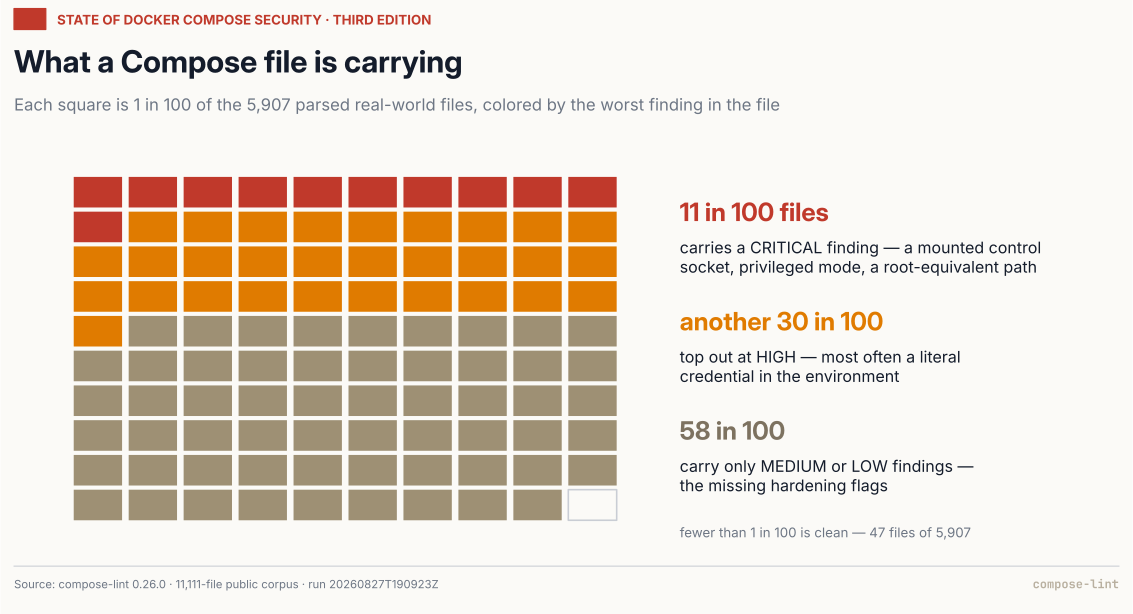
The MEDIUM-heavy distribution is a property of compose-lint's rule design, not of the corpus: the hardening misses that fire on nearly every file sit at MEDIUM. CRITICAL findings are rarer but not marginal: 10.6% of parsed files carry at least one CRITICAL finding, and 7.8% carry a mounted host control socket specifically. Broadening to HIGH-or-above, 40.8% of parsed files carry at least one finding rated HIGH or CRITICAL — the jump from the previous edition's 34.2% is mostly the credential rules reading env_file: contents they previously could not (see the delta).
LOW is one rule. The 13,724 LOW findings are 99.8% CL-0007 (filesystem not read-only, 13,694); the remaining 30 come from CL-0014 (20), CL-0017 (5), and CL-0022 (5) — rules that fire only when a file explicitly opts out of a default. Read the LOW tier as "almost every file omits read_only: true".
Skipped is not clean¶
In plain terms: some files exit the linter successfully with zero findings because there was nothing in them to lint — an obsolete Compose v1 layout (services at the top level, retired by Docker in 2023) or a structural fragment with no services. Earlier editions counted those as "clean", which quietly inflated the clean population; the previous edition's statistical review caught 438 of them by hand. The harness now separates them by construction.
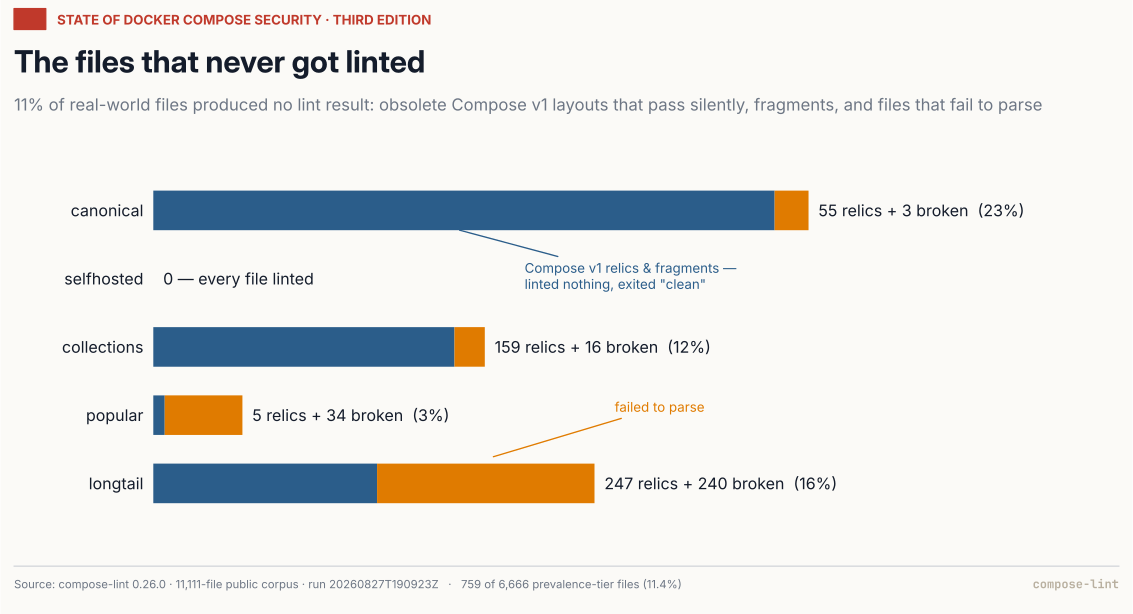
This edition's skip population: 466 files in the prevalence tiers (447 Compose v1, 19 fragments) — 7.0% of those tiers — concentrated in longtail (247) and collections (159). With them out of the denominator, genuinely clean files number 47 of 5,907 (0.8%): 46 in longtail, 1 in collections, and zero in canonical, selfhosted, or popular. The v1 population is fossil material — 61% of ≥5-year-old files vs ~1% of files under a year old — and the deeper sweep behind this edition surfaces proportionally far less of it.
Per-tier breakdown¶
Files with at least one finding¶
| Tier | Total | Parsed | Skipped | Parse-err | With findings | Clean | Rate (of parsed) | Findings per parsed file | Source repos |
|---|---|---|---|---|---|---|---|---|---|
canonical |
249 | 191 | 55 | 3 | 191 | 0 | 100% | 13.21 | 8 |
selfhosted |
596 | 596 | 0 | 0 | 596 | 0 | 100% | 9.37 | 4 |
collections |
1,485 | 1,310 | 159 | 16 | 1,309 | 1 | 99.9% | 9.98 | 16 |
popular |
1,231 | 1,192 | 5 | 34 | 1,192 | 0 | 100% | 19.93 | 734 |
longtail |
3,105 | 2,618 | 247 | 240 | 2,572 | 46 | 98.2% | 14.11 | 2,583 |
The "Source repos" column matters as much as the file counts: a tier built on few repos describes those repos, however many files they contribute — selfhosted is four registries, canonical eight vendors. With the skip artifact gone, the with-findings rate has stopped being an interesting axis of comparison (every tier is at or near 100%, longtail's 98.2% carrying a repo-resampling interval of 97.7–98.7%); the discriminating numbers are findings per file, per service, and the acute-rule rates below.
The fair comparison: per service, not per file¶
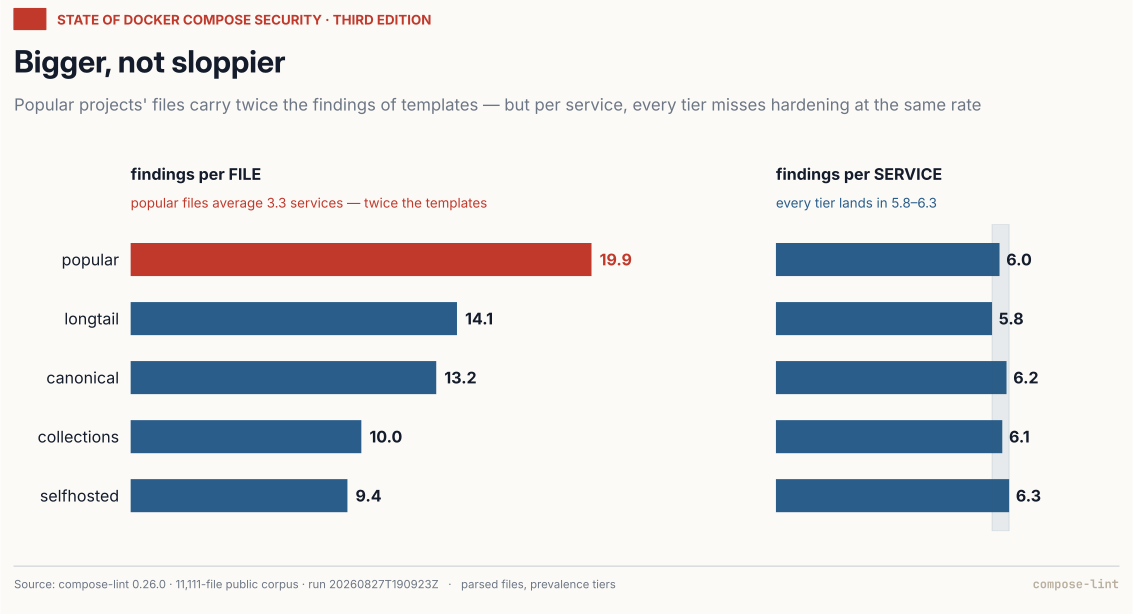
In plain terms: a file with six services has six chances to miss a hardening flag. Per-file comparisons across tiers whose files differ in size partly measure file size; the per-service view is the fair one.
| Tier | Services per file | Findings per service | Files w/ CRITICAL | Files w/ HIGH+ | Socket: files | Socket: services |
|---|---|---|---|---|---|---|
canonical |
2.14 | 6.19 | 8.9% | 45.5% | 7.3% | 4.4% |
selfhosted |
1.50 | 6.26 | 9.4% | 31.4% | 5.2% | 3.5% |
collections |
1.64 | 6.07 | 11.6% | 39.9% | 7.6% | 5.0% |
popular |
3.32 | 6.00 | 19.5% | 52.3% | 16.1% | 6.0% |
longtail |
2.43 | 5.80 | 6.4% | 37.9% | 4.7% | 2.4% |
Findings per service is nearly flat — 5.8 to 6.3, everywhere. The per-service miss rate is universal: whoever writes a Compose service, it ships without hardening at the same rate. What differs is stack size — ordinary projects write 3.3 services per file — so a real project's file accumulates twice a template's exposure, and one in five popular files carries a CRITICAL finding. On the control socket (CL-0001), two claims survive the noise check (§ statistician's reading): popular services mount it ~2.5× as often as longtail services, and every curated/popular tier sits well above the longtail. The popular-vs-collections per-service difference is within the noise and is not claimed.
Top findings¶
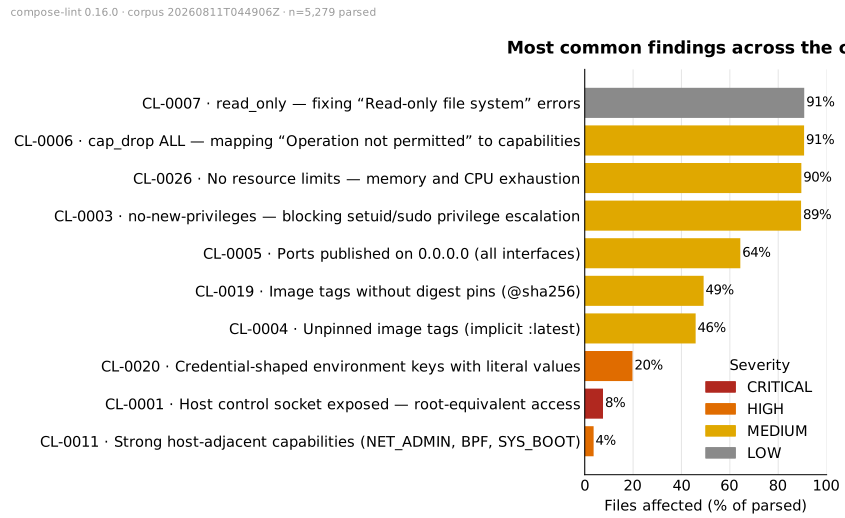
Ten rules account for 98% of all findings. They cluster into three groups: hardening defaults that nobody flips, supply-chain shortcuts, and acute privilege grants.
Hardening defaults (the bulk of the findings)¶
| Rule | Severity | Files affected | Share of parsed |
|---|---|---|---|
| CL-0007 Filesystem not read-only | LOW | 5,833 | 98.7% |
| CL-0006 No capability restrictions | MEDIUM | 5,826 | 98.6% |
| CL-0026 No resource limits | MEDIUM | 5,754 | 97.4% |
| CL-0003 Privilege escalation not blocked | MEDIUM | 5,748 | 97.3% |
Each is a missing hardening flag rather than an active misuse. That each fires on ~98% of files — with the not-really-Compose files now out of the denominator — is the central observation of the report: the Compose hardening set (read_only: true, cap_drop: [ALL], security_opt: [no-new-privileges:true], a deploy.resources.limits block) is essentially never set. The four move together: one habit, absent.
Network and supply-chain shortcuts¶
| Rule | Severity | Files affected | Share of parsed |
|---|---|---|---|
| CL-0005 Ports bound to all interfaces | MEDIUM | 4,252 | 72.0% |
| CL-0019 Image tag without digest | MEDIUM | 2,967 | 50.2% |
| CL-0004 Image not pinned to version | MEDIUM | 2,963 | 50.2% |
Acute privilege grants¶
| Rule | Severity | Files affected | Share of parsed |
|---|---|---|---|
| CL-0020 Credential-shaped env key with literal value | HIGH | 1,660 | 28.1% |
| CL-0001 Host control socket exposed | CRITICAL | 458 | 7.8% |
| CL-0021 Credential embedded in connection-string env value | HIGH | 301 | 5.1% |
| CL-0011 Strong host-adjacent capability added | HIGH | 205 | 3.5% |
| CL-0008 Host network mode | HIGH | 164 | 2.8% |
| CL-0013 Sensitive host path exposed | HIGH | 148 | 2.5% |
| CL-0002 Privileged mode enabled | CRITICAL | 141 | 2.4% |
Plaintext credentials are the most common acute finding, and the 0.26.0 rule set sees far more of them: CL-0020 fires on 28.1% of parsed files (19.7% in the previous edition) — the tool now reads env_file: contents and resolves nested variable defaults, catching credentials the earlier edition missed on the same files. Better than one in four public Compose files commits a literal credential. The remaining rules each fire on under 2% of files; all 27 registered rules fire somewhere in the corpus — a rule at a fraction of a percent is not dead, it is specific.
The overlay lane¶
New in this edition: 3,579 overlay/variant files (docker-compose.override.yml, *.prod.*, *.dev.*, *.staging.*, *.local.*, …), previously invisible to the corpus's filename allowlist. Reported as their own lane — an overlay is a merge fragment, and linting it standalone is the partial view compose-lint's coverage-gap machinery exists to warn about. Three findings:
- The fragment hypothesis is mostly wrong. 97% lint standalone (3,487 of 3,579; 13 v1/fragment skips, 79 parse errors), at 3.48 services per file — as large as popular projects' main files. Real-world multi-environment usage is overwhelmingly "full parallel file per environment", not "base plus sparse patch". That reorders the priorities for
include:/extends:/merge support. - Dev and local overlays are credential dumps. Literal-credential rates (CL-0020/21):
dev34%,local36% — 1.7× the full-file rate — whileprod/production/overridesit at ~20–21%, which still means one in five production overlays hardcodes a credential. Port publishing also concentrates here (76% of overlays vs 72% of full files, peaking inlocalat 82%). - Overlays are current practice: 48% authored within a year of the snapshot, 79% within three. This surface is live and growing, not legacy.
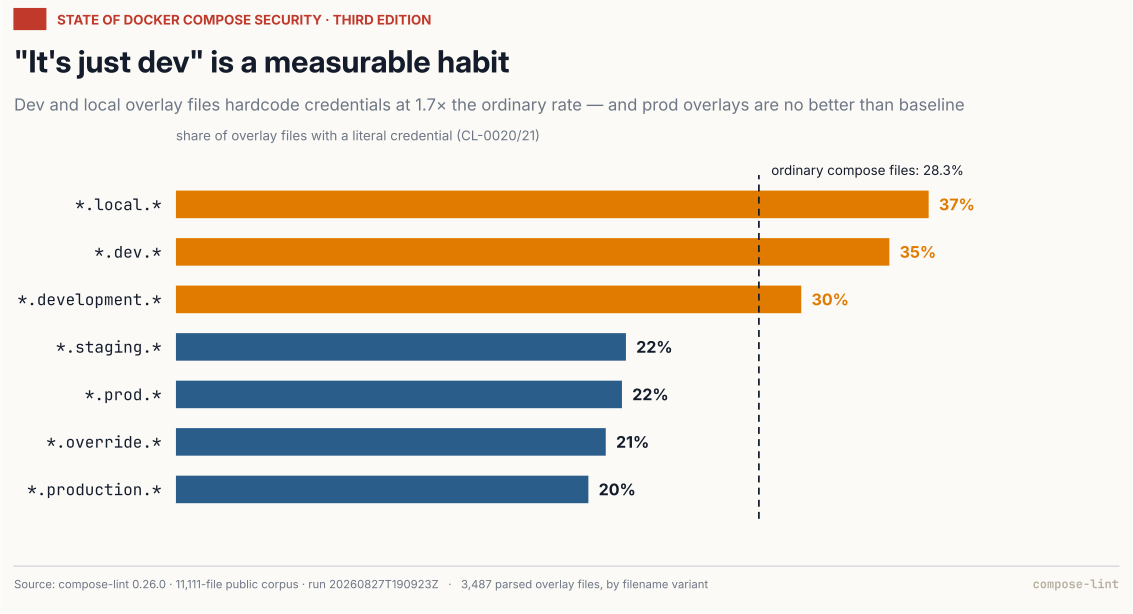
Their per-service findings rate (≈5.4) sits just below the full-file band — overlays are ordinary unhardened Compose, in greater numbers, in more places.
Is practice improving over time?¶
No — and the claim has now been replicated. Each file's blob_authored_at records when the captured content was last authored (coverage: 99% of the corpus).
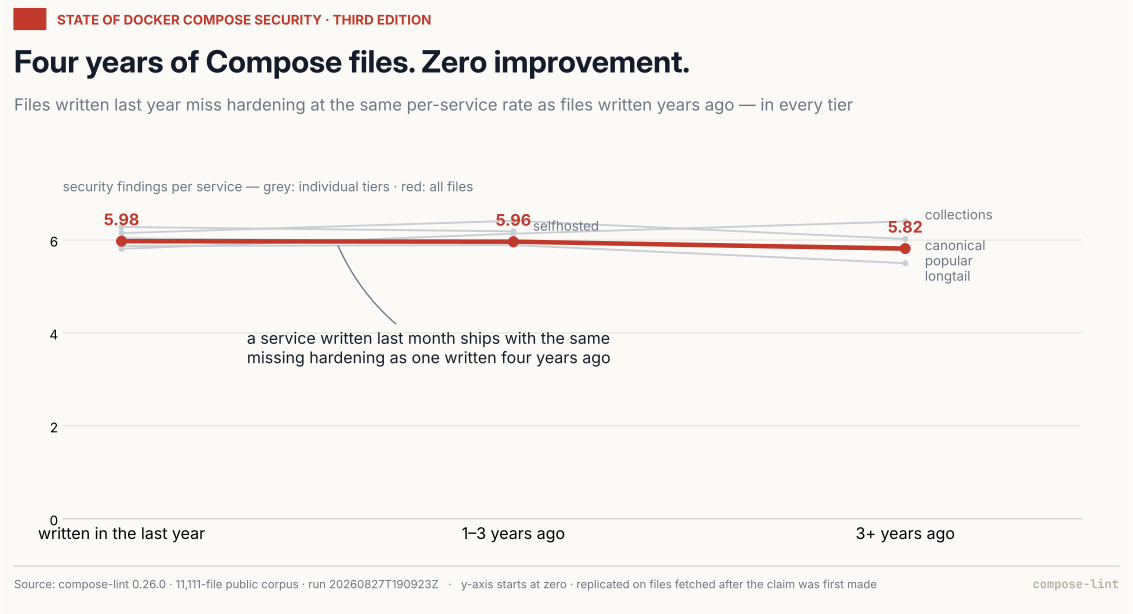
Findings per service, by file age, within each tier:
| Tier | <1y | 1–3y | ≥3y |
|---|---|---|---|
canonical |
6.15 | 6.41 | 6.02 |
selfhosted |
6.28 | 6.19 | — |
collections |
5.81 | 6.14 | 6.40 |
popular |
6.04 | 5.95 | 5.79 |
longtail |
5.87 | 5.89 | 5.50 |
| All prevalence | 5.98 | 5.96 | 5.82 |
Flat, everywhere. A compose file written in the twelve months before the snapshot misses hardening controls at the same per-service rate as one written three or more years earlier — in every tier, and confirmed a second time on 2,035 files fetched after the claim was first derived. The hardening gap is not legacy debt waiting to age out; it is how Compose files are being written now.
The corpus is fresher than its reputation — 44% of dated files were authored within a year of the snapshot, 74% within three — and the age data independently corroborates the skip population: the v1 relics concentrate exactly where an age model says obsolete formats should (61% of ≥5-year-old files vs ~1% of recent ones). One methodology note the deeper sweep exposed: the previous editions' 200-hit-per-query cap skimmed GitHub's relevance-ranked head, which over-samples old files — the deep stratum is markedly younger (11% ≥5y vs 28%).
What changed since the last edition¶
The previous edition's 5,417 files are archived and were relinted with 0.26.0 — same files, same attribution, only the tool moved. That isolates two weeks of rule-set change:
- Findings on the same files: +1.1% (60,730 → 61,396), with zero files flipping between "has findings" and "clean" in either direction. The corpus verdicts are stable across ten releases.
- The growth is concentrated where the tool learned to see: CL-0020 +458 and CL-0021 +100 (the
env_file:reader and nested-interpolation fixes let the credential rules read values they previously could not — this, not behavior change in the wild, is why the credential rate jumped between editions), CL-0029 +72 (a rule that did not exist at 0.16.0), CL-0025 +21, and a ±293 reclassification pair between CL-0019 and CL-0004 at the tag/digest boundary. - 476 files that 0.16.0 "linted" are now skipped as v1/fragments — the vacuous-clean population, formally retired from the denominator.
No comparison is made against the 0.7.0 edition; its corpus no longer exists and nothing about it can be differenced.
Parse errors as a finding¶
293 prevalence-tier files (4.4% of the tiers' 6,666) failed to lint as v2/v3 Compose — distinct from the 466 skipped v1/fragment files, which exited cleanly having linted nothing. The dominant classes remain shape errors, not malformed YAML: services-not-mapping 116, service-not-mapping 77, invalid-yaml 38, include:-based files compose-lint declines to lint standalone 35, empty-file 18, others 9. The include: count — 35, up from 5 — is the deep sweep finding real multi-file adoption, consistent with the overlay lane's story. Longtail carries the bulk (240 errors, 7.7% of the tier): a compose file that doesn't parse isn't deployed by a real engine, so these are documentation, copy-paste fragments, and first attempts — none of which get linted before they ship.
A statistician's reading of these numbers¶
This section is the report's own statistical review — the questions a methods referee would ask, asked of ourselves, each answered first in plain terms and then precisely. It was introduced in the previous edition's revisions; this edition carries it forward against the new run.
What "n" really is: files cluster by repo¶
In plain terms: two files from the same repo were usually written by the same person with the same habits; counting them as independent observations overstates the evidence. The prevalence tiers span 3,345 repos for 6,666 files — very unevenly. selfhosted is 596 files from 4 registries; canonical is 8 vendor repos; popular (734 repos) and longtail (2,583) are genuinely diverse. Every tier claim above prints its source-repo count, and rate comparisons are made only where repo-resampling (cluster bootstrap over repos, not files) separates them: longtail's with-findings interval is 97.7–98.7%, the other tiers' are degenerate at 100%. The selfhosted and canonical numbers describe those few sources, not self-hosting or vendors at large.
When we call a difference real¶
Two rates are treated as different only when their repo-resampling intervals separate. That rule is why "popular services mount the socket ~2.5× longtail services" is claimed, the popular-vs-collections socket difference is not, and per-service findings rates (5.8–6.3 across tiers) are described as flat rather than ranked.
Denominators are declared¶
Three populations are reported separately and never blended: parsed (linted, findings possible), skipped (exited cleanly, nothing linted — v1/fragments), and parse errors (refused). Prevalence claims use parsed only. The previous edition's revisions documented how folding skips into "clean" understated the headline by ~9 points; the harness now makes that mistake structurally impossible, and this edition's 99.2% needs no floor/ceiling hedging.
The replication test¶
The tier-attribution rules (the synthetic path set, the lab and tool-repo lists, the ≥20-file collections threshold) were frozen before this edition's sweep, so the fresh data is a genuine out-of-sample test of the previous edition's claims. On 2,035 longtail files that existed in no prior analysis: with-findings 98.4% (prior lane: 97.9%), findings per service 5.85 (5.59), socket-per-service low as claimed, per-service-by-age flat (5.88 / 5.96 / 5.62) — and the frozen rules routed every unseen file without manual correction (78 to synthetic, 2 to lab; longtail retained its one-file-per-repo diversity at depth, 2,013 repos for those 2,035 files). The load-bearing claims of this report were derived on one dataset and confirmed on another.
Related work¶
- Ibrahim, Truong, Wadia, Zhang & Wahsheh (EMSE 27(1), 2021). A study of how Docker Compose is used to compose multi-component systems. Springer link. The closest existing corpus study of Docker Compose — composition patterns, not security. This report's tier model is partly informed by their findings on heterogeneity between hobbyist and production usage.
- Liu, Wang, Tao & Lu (ESORICS 2020). A large-scale empirical study of Docker container security. Paper PDF. A Docker Hub image corpus study that flags
docker-compose.ymlas an underexplored attack surface. This report is a direct response to that gap.
What this study does NOT claim¶
Out of scope by design¶
- Exploit rate. Findings count misconfigurations that violate hardening guidance, not observed exploitation. A finding is a code smell with a citation, not an attestation of compromise.
- Runtime behavior. compose-lint reads YAML; it does not run containers. The corpus shows what people write, not what their containers do once started.
- Production usage. A compose file in a public repo is evidence that someone wrote it, not that anything runs it.
- Private-repo prevalence. Public GitHub only; enterprise-internal distributions may differ.
Sampling caveats¶
- GitHub-only. No GitLab, Codeberg, Bitbucket, Docker Hub snippets, or blog YAML. Query design and inherited biases:
scripts/corpus/README.md. - Filename-pinned. The main tiers cover the four spec filenames; the overlay lane covers 28 variant basenames. Files under fully non-standard names (
stack.yml, …) remain unsampled — a considered omission, not an oversight. - Search-depth bias, now measured. Shallow (200-hit) sweeps over-sample GitHub's relevance-ranked head, which skews old; this edition's 1,000-hit sweep measures the difference (fresh stratum: 11% of files ≥5y old vs 28% in the shallow-swept portion). Treat cross-edition longtail age mixes accordingly.
- Size stratification distorts the size mix. Equal query effort per size bucket over-samples large files relative to natural frequency — one more reason per-service rates are the fair cross-tier comparison.
- Excluding unparseable files is itself a selection. Parse failures concentrate among beginner-authored longtail files, plausibly the least hardened; longtail rates over parsed files likely flatter the tier's authors.
- No statistical inference. Descriptive sampling for prevalence estimation: no hypothesis tests, no population estimates. The repo-resampling intervals describe the stability of rates under reshuffling of this sample's repos; they are not confidence intervals for GitHub at large.
- Exclusions are intent judgments. The
synthetic/lab/overlaylines are deterministic and published (scripts/corpus/retier.py), but where they're drawn is a judgment; every excluded lane's numbers are reported so a reader can re-blend. - Editions are not a time series — except where stated. The same-files delta above is measured on the archived previous snapshot and is legitimate. Nothing else across editions is.
Tool caveats¶
- Rules are based on hardening guidance, not incident data. A firing rule means divergence from OWASP/CIS/Docker guidance, not observed exploitability.
- compose-lint does not validate the full Compose schema. v1 files and structural fragments are skipped with a note (counted in § Skipped is not clean); parse failures are bucketed by class;
${VAR:-default}interpolation resolves to the value Compose ships when the variable is unset; externalextends:/include:files are not merged, and files that require them are refused rather than half-linted.
Reproducibility¶
The corpus is not committed to the repo (third-party content), but the pipeline that builds it is, and the snapshot is archived. The reproducible path:
git clone https://github.com/tmatens/compose-lint
cd compose-lint
python -m venv .venv && .venv/bin/pip install compose-lint==0.26.0

# Restore the archived snapshot this edition is measured on.
# sha256 049d2b5bf7167f0ca694aca23fa5483c761fbfccfa2ca7b78520a4ba8b3a5f98
# (previous edition's 5,417-file snapshot, kept for provenance and for
#  reproducing the same-files delta: compose-lint-corpus-5417-20260811-r2.tar.gz,
#  sha256 1d25274a97d3029e708b6eced3ef4dbaf1a1843c60925f0f035fa9df0574f583)
mkdir -p ~/.cache/compose-lint-corpus
tar -xzf compose-lint-corpus-11111-20260827.tar.gz -C ~/.cache/compose-lint-corpus

# Lint the corpus and write summary.md + tier_summary.md.
COMPOSE_LINT_BIN=$PWD/.venv/bin/compose-lint python scripts/corpus/run.py

# Re-render the charts (matplotlib is a maintainer-only extra)
pip install -e '.[corpus]'
python scripts/corpus/charts.py latest
Snapshot archives are held by the maintainers and identified by the sha256 values above; open an issue on the tracker for a copy to verify a number against. The summary.md and tier_summary.md in runs/<ts>/ are the source artifacts every table here is built from; charts.py reads the same aggregation, so the figures in docs/assets/ can never disagree with the tables.
Why re-fetching does not reproduce this corpus. The curated tiers re-fetch closely and the derived tiers (collections, synthetic, lab, overlay) are deterministic given an index, but the longtail tier is a stratified sweep of a search engine that offers no random-document primitive and no stable result sets. A re-fetch produces a longtail, not this one — which is why each edition's snapshot is archived as a file, and why only archived-snapshot relints (like this edition's delta) may carry comparisons.